



Scientific research on bedwetting alarms
Scientific research shows that bedwetting alarms can be an effective treatment for nocturnal enuresis in children. Clinical studies and systematic reviews indicate that many children achieve dry nights through bedwetting alarm training. Research also suggests that children who successfully complete alarm treatment may be less likely to experience a relapse than those treated with desmopressin. Results vary depending on the child, consistency of training and parental support.
How effective are bedwetting alarms?
Bedwetting alarms, also known as enuresis alarms or moisture-sensing alarms, have been used for decades to treat bedwetting (nocturnal enuresis) in children and adults. Many scientific studies have examined how effective these alarms are. Researchers have also looked at how alarms compare with other treatments and whether the results last after treatment ends.
Overall, research shows that bedwetting alarms can be an effective treatment for many children. They can be particularly helpful when the alarm is used consistently and the child receives positive support during the training process.
Some studies report that around 70–90% of children can benefit from alarm treatment when the alarm is used correctly and consistently. Other reviews report that up to around 80% of children can become dry during treatment.
Several factors can influence the effectiveness of an alarm. These include the child’s age, motivation and consistency during training. Support from parents is also important. Some children respond quickly, while others need more time and continued training.
Bedwetting alarms versus medication
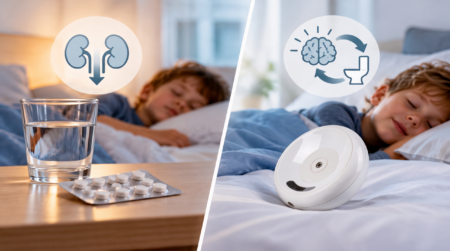
Medication, such as desmopressin, is another commonly used treatment for bedwetting. Desmopressin works by temporarily reducing the amount of urine produced by the kidneys during the night. This can be useful in certain situations and can provide relatively rapid improvement, but bedwetting may return when the medication is stopped.
Bedwetting alarms work differently. Rather than reducing nighttime urine production, they aim to help the child learn to recognise the sensation of a full bladder and wake up to use the toilet. This learning process is one of the reasons why alarm treatment can have more lasting results for some children.
Bedwetting alarms versus medication
Medication, such as desmopressin, is another commonly used treatment for bedwetting. Desmopressin works by temporarily reducing the amount of urine produced by the kidneys during the night. This can be useful in certain situations and can provide relatively rapid improvement, but bedwetting may return when the medication is stopped.
Bedwetting alarms work differently. Rather than reducing nighttime urine production, they aim to help the child learn to recognise the sensation of a full bladder and wake up to use the toilet. This learning process is one of the reasons why alarm treatment can have more lasting results for some children.
Research reviews have found that alarms and desmopressin can both be effective during treatment. However, children treated with an alarm may be less likely to relapse after treatment has ended than children treated with desmopressin alone. This difference is particularly relevant when the goal is long-term dryness rather than temporary control of bedwetting.
The best treatment depends on the individual child and family. Factors such as the child’s motivation, the severity of bedwetting, family circumstances and the need for rapid or long-term results can all influence which approach is most appropriate.
Long-term benefits
One of the most important findings in research on bedwetting alarms is the potential for lasting results. Bedwetting can return after treatment with some approaches, particularly when treatment only controls nighttime urine production while it is being used. Alarm treatment may have a lower relapse rate because it aims to help the child develop a lasting response to bladder signals.
A Cochrane review of alarm interventions for nocturnal enuresis found that alarms can be effective in achieving sustained dryness, although the quality and results of individual studies vary. Research comparing alarms with desmopressin has also found that bedwetting may be less likely to return after successful alarm treatment than after treatment with desmopressin.
This does not mean that every child who uses a bedwetting alarm will remain permanently dry. Some children need a longer period of training, and some may experience a return of bedwetting. Nevertheless, the potential for lasting improvement is an important advantage of alarm treatment and one of the reasons why bedwetting alarms are recommended as a treatment option for nocturnal enuresis.
Impact on quality of life
Bedwetting is not only a physical issue. Regularly wetting the bed can affect a child’s confidence and emotional well-being and can make activities such as sleepovers, school trips and staying with friends more difficult. Research has shown that nocturnal enuresis can have a negative impact on children’s quality of life, including their social, emotional and psychological well-being.
Successful treatment can therefore have benefits that go beyond achieving dry nights. Research into the effects of bedwetting treatment suggests that reducing or resolving bedwetting can be associated with improvements in self-esteem, confidence and emotional well-being.

Bedwetting alarms can contribute to this improvement by helping children actively participate in their treatment. Rather than simply taking medication, the child learns to respond to the alarm and gradually recognise their own bladder signals.
It is important that bedwetting alarm training is approached positively. Bedwetting is not something a child does deliberately, and accidents during training should never be treated as a failure. Encouraging effort and progress can help prevent unnecessary pressure and support a more positive training experience. Positive encouragement from parents can also help children remain motivated and feel involved in the process.
Conclusion
Scientific research supports the use of bedwetting alarms as an effective treatment option for children with nocturnal enuresis. Studies and systematic reviews show that many children achieve dry nights with alarm treatment, although success rates and treatment outcomes vary between individuals and studies.
Bedwetting alarms differ from medication because they are designed to help children learn to respond to bladder signals during sleep. This learning process may explain why successful alarm treatment can provide more lasting results and lower relapse rates than some other treatment approaches.
In addition to helping children achieve dry nights, successful treatment can have a positive effect on confidence, self-esteem and quality of life. For many children, a bedwetting alarm therefore offers more than a way to manage wet nights: it can be a tool to support them in learning to stay dry.